When Compliance Was a Binder
In the early 1980s, “Governance, Risk, and Compliance” (GRC) wasn’t an acronym; it was a physical three-ring binder. It sat on a shelf behind the Chief Internal Auditor’s desk, smelling of freshly mimeographed paper and good intentions. If an auditor asked for evidence, you walked down the hall, pulled a manila folder, showed a blue-ink signature on a carbon-copy voucher, and everyone slept well at night.
Forty years later, that world is gone.
Today, a single automated transaction can touch a customer’s phone in Dubai, route through a core-banking API hosted in a hyperscaler cloud, invoke an algorithmic credit-scoring model, and settle across borders in seconds.
Too many practitioners treat GRC as a paperwork exercise—a checklist run by nervous folks in the basement to stop the business from doing business. But real GRC is not the brake pedal of an automobile. GRC is the steering wheel and the anti-lock braking system (ABS): it allows the business to drive at 200 kilometers per hour safely around sharp curves without rolling over.
If you are a Chief Information Security Officer (CISO), a Chief Risk Officer (CRO), a board director, or a newcomer trying to figure out what all these acronyms mean, welcome. Let’s demystify the modern GRC federation—its twelve core pillars, its architectural crosswalks, and how to build a program that genuinely defends the enterprise.
1. The Regulatory Trigger
The regulatory climate has shifted from passive compliance (showing you have a policy document) to active operational resilience and algorithmic defensibility (proving your controls withstand a real-world shock).
Across global financial hubs—from London and Frankfurt to Riyadh and Abu Dhabi—regulators have run out of patience with “tick-box” compliance:
- The Central Bank of the UAE (CBUAE) has tightened its Consumer Protection Standards, Stored Value Facilities, and Cloud Computing frameworks, alongside Federal Decree-Law No. 45/2021 (UAE Data Protection Law).
- The Saudi Central Bank (SAMA) enforces stringent Cyber Security Frameworks (CSF) and Business Continuity Management mandates alongside the Saudi Personal Data Protection Law (PDPL).
- Globally, frameworks like the EU Digital Operational Resilience Act (DORA) and the EU AI Act make board members personally accountable for third-party ICT failures and untamed machine learning model
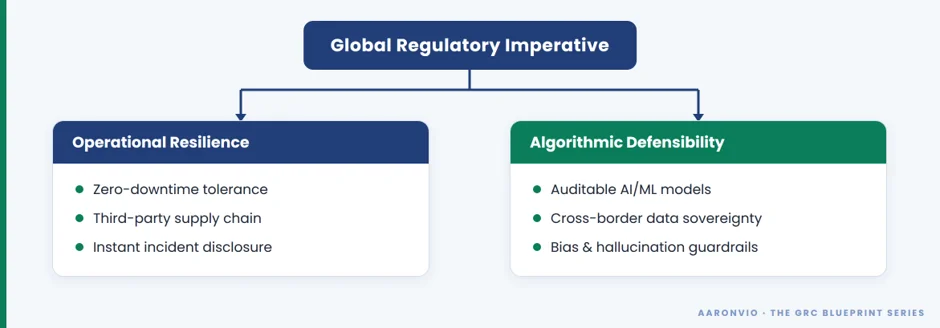
- The Core Takeaway: GRC is no longer a collection of isolated departments. If your Cybersecurity team doesn’t speak to your Data Privacy Officer, and your Privacy Officer doesn’t understand your Cloud Vendor Contracts, you have built a house of cards.
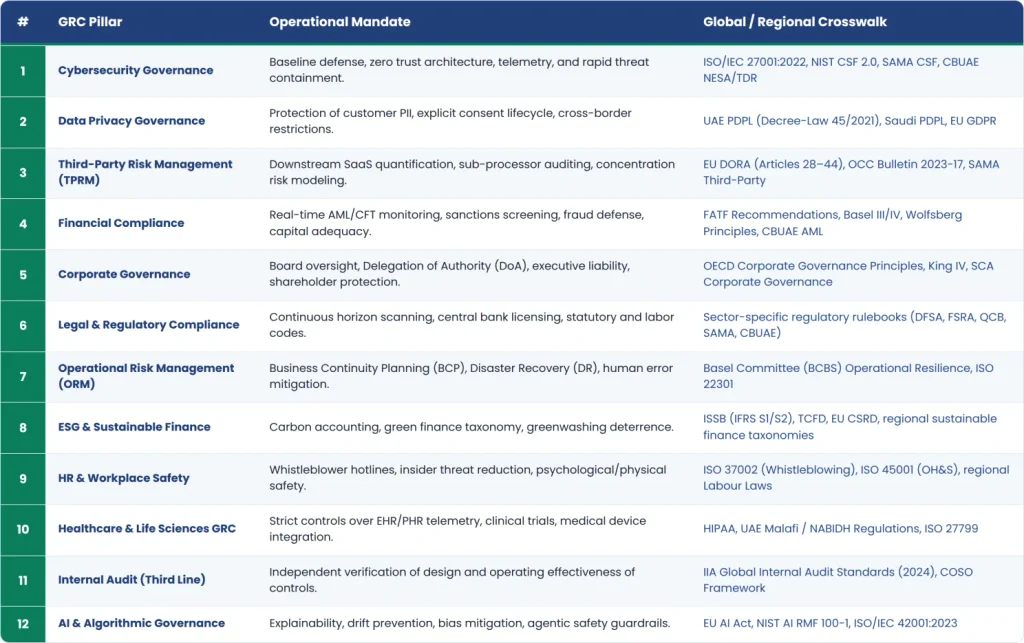
2. The Twelve Pillars of Modern GRC: The Architectural Crosswalk
In a mature enterprise, these twelve typologies feed into one another like an integrated circuit board. Below is our blueprint showing how operational realities map directly to regional and global framework
3. Governance Terminology: Real Interpretations
Too many junior consultants drown in jargon. Let’s translate the most misunderstood terms into clear business English:
- Risk Appetite vs. Risk Tolerance: Appetite is how much spicy food you are willingly prepared to order (e.g., “We accept the risk of expanding into real-time cross-border retail payments”). Tolerance is how much heartburn you can medically endure before going to the emergency room (e.g., “We cannot tolerate more than $50,000 per day in unrecovered synthetic identity fraud”).
- The Three Lines Model (IIA): First Line (Business & IT): Owns and executes the risk. If you write the code, operate the branch, or approve the loan, you are the defense line. Second Line (Risk, Compliance, Information Security): Sets the policies, provides monitoring tools, reviews metrics, and blows the whistle when the First Line drifts out of bounds. Third Line (Internal Audit): Reports directly to the Board Audit Committee. They check whether Lines 1 and 2 are actually doing what they claim on paper.
- Algorithmic Drift: When an AI model’s training assumptions no longer match the real world (e.g., an automated underwriting model trained during zero-interest-rate years suddenly making catastrophic assumptions in a high-inflation cycle).
- Concentration Risk (In the Cloud Era): Relying on one vendor so heavily that if they suffer an outage, your entire business line halts—and you discover half of your third-party SaaS vendors were hosted in the very same data center.
4. Risk Assessment & Threat Modeling: Step-by-Step
A good risk assessment is an honest conversation about what can go wrong, how likely it is, and what it costs.
The Simple, Pragmatic 5-Step Formula
- Asset Identification & Valuation: Don’t start with threats; start with jewels. Is it the Swift gateway? The core customer database? The AI credit-decision engine?
- Threat Modeling: Use practical threat modeling frameworks: STRIDE (Spoofing, Tampering, Repudiation, Information Disclosure, Denial of Service, Elevation of Privilege) for banking software and APIs. MITRE ATT&CK for threat-actor behaviors. OWASP Top 10 for LLMs for emerging Generative AI deployments (prompt injection, sensitive data leakage).
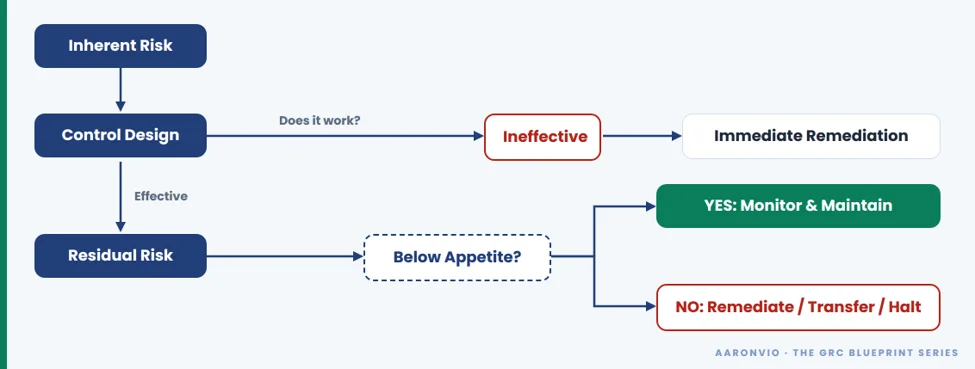
- Inherent Risk Scoring: Assess Impact × Likelihood assuming zero controls exist.
- Control Effectiveness Evaluation: Inspect existing safeguards. Are they automated or manual? Detective or preventative?
- Residual Risk Calculation: Inherent Risk minus Control Mitigation. Does the leftover risk sit inside your board-approved Risk Appetite? If not, you have three options: Remediate, Transfer (Insurance), or Terminate the activity. (Note: “Risk Acceptance” should be a painful, highly escalated process, not a casual rubber stamp)
5. Moving from “Manual Checks” to “Automated Telemetry”
The greatest operational friction in banking comes from poorly designed controls. If a control requires an overworked employee to copy data from one Excel sheet to another every Friday morning, that control is guaranteed to fail.
Anatomy of an Elite GRC Control
- Preventative over Detective: Block unauthorized cloud storage access via code (e.g., infrastructure-as-code guardrails) rather than scanning for open buckets once a month.
- Continuous Control Monitoring (CCM): Instead of testing sample transactions once a year during audit season, use API collectors that check access revocation, patching schedules, and encryption key rotation every five minutes.
- Fail-Safe Defaults: If your customer-facing AI credit bot encounters prompt injection or anomalous data, it should gracefully drop into a human-review queue rather than guess or hallucinate.
6. Real-World Case Studies & Regulatory Enforcement
Experience is simply the name we give our mistakes; wisdom is learning from other people’s balance sheets.
Case 1: The Invisible Sub-Processor (Third-Party Failure)
- The Incident: A Tier-1 retail bank deployed a modern fintech plug-in to offer micro-investments to mobile banking users. The bank conducted a rigorous security review of the fintech. However, the fintech utilized an unvetted offshore machine learning API for document optical character recognition (OCR).
- The Fallout: Passport scans and unmasked national identification cards of 400,000 citizens were processed and cached in an insecure server overseas.
- The Penalty: Multimillion-dollar regulatory fines for violating cross-border data sovereignty mandates (including strict UAE/Saudi PDPL and GDPR extraterritorial clauses), accompanied by a formal freeze on the bank’s mobile feature launches for six months.
- The Lesson: Fourth-Party Risk (Nth-party risk) is your risk. You cannot outsource legal accountability.
Case 2: The Hallucinating Underwriter (AI Governance Failure)
- The Incident: A consumer credit firm deployed a neural-network-driven scoring model to approve small-business working-capital loans within minutes.
- The Fallout: An internal probe sparked by customer complaints revealed that the model systematically degraded credit scores for businesses run by minority demographics—not because it was programmed to do so, but because historical loan rejection data contained structural historical bias. Furthermore, the model could not produce an interpretable reason code for rejections.
- The Penalty: Immediate enforcement order to halt automated approvals, mandatory individual re-underwriting of tens of thousands of applications, severe reputational brand damage, and penalties for failing algorithmic explainability standards under modern consumer protection mandates.
- The Lesson: “The algorithm did it” is not a defense in a court of law or a central bank hearing room. If you cannot explain the output, you do not own the process.
7. Operational Pitfalls, Friction & How to Avoid Them
Over four decades, I have watched brilliant GRC programs collapse under their own weight. Here is why:
- Creating the “Department of No”: If the compliance team sees their job as stopping every project, developers and business managers will build shadow systems around them. Compliance must be internal management consultants who say: “Here is how you can do that legally and safely.”
- Framework Overload: Organizations try to adopt NIST, ISO, COSO, and COBIT simultaneously with separate spreadsheets for each. Normalize your controls. One strong access control standard fulfills ISO 27001, NIST CSF, SAMA, and CBUAE at the same time.
- Ignoring the Human Element: The best firewall in the world cannot stop an executive who approves an emergency supplier invoice redirection because an email looked urgent. Workplace safety, ethical culture, and continuous awareness are the real baseline of operational risk.
8. Defensibility, Audit Preparation & Artifact Checklist
When an external auditor or central bank inspector knocks on the door, your state of mind shouldn’t be panic; it should be quiet confidence.
Defensibility means “If it isn’t documented and time-stamped, it didn’t happen.”
The Core Audit Artifact Checklist
- Board-Approved Risk Appetite Statement (RAS): Updated within the last 12 months with explicit thresholds for cyber, credit, and AI model risk.
- Delegation of Authority (DoA) Matrix: Signed, clear spending and operational sign-off limits without ambiguity.
- Data Lineage & Asset Inventory: Current register of all critical infrastructure, databases, third-party APIs, and AI models in production.
- Third-Party Risk Assessments: Validated SOC 2 Type II reports, penetration testing summaries, and signed Data Processing Agreements (DPAs) for every active SaaS vendor.
- Incident Response Post-Mortems: Minutes, root-cause analyses, and verified evidence of closed corrective action items from historical tabletop simulations.
- AI Model Documentation: Architecture documentation, training data validation logs, explainability frameworks (SHAP/LIME outputs), and bias-testing records.
9. Implementation Roadmap & Stakeholder RACI
Rome wasn’t built in a day, and a federated GRC architecture isn’t built in a single quarter. Here is a battle-tested four-phase roadmap:
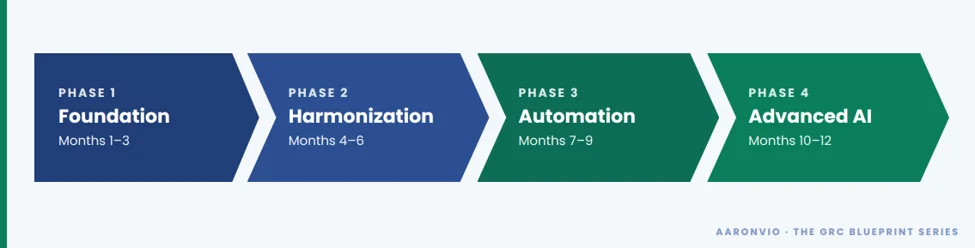
- Phase 1: Foundation (Months 1–3): Asset discovery, policy harmonization, and establishing the unified GRC steering committee.
- Phase 2: Harmonization (Months 4–6): Crosswalk mapping across regulatory mandates; establish a central Risk Register and automated TPRM intake process.
- Phase 3: Automation & Telemetry (Months 7–9): Transition to continuous control monitoring (CCM), integrate SIEM/SOAR with the GRC platform, implement unified incident handling.
- Phase 4: Advanced Governance & AI Oversight (Months 10–12): Deploy AI inventory registries, establish algorithmic bias review boards, and execute board-level crisis simulations.
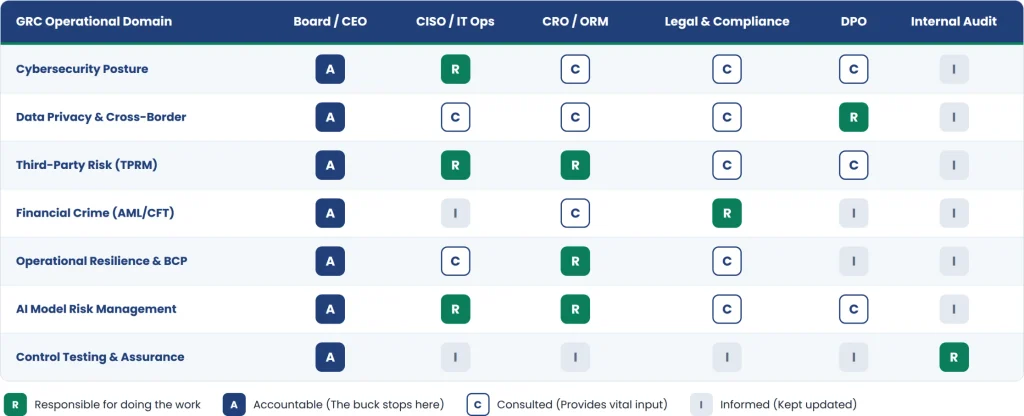
The Stakeholder RACI Matrix
- R = Responsible for doing the work
- A = Accountable (The buck stops here)
- C = Consulted (Provides vital input)
- I = Informed (Kept updated)
Veteran’s Parting Advice: How to Sleep at Night
If you remember only three principles from my four decades in the trenches, remember these:
- Complexity is the natural enemy of security and compliance. The thicker your policy document, the less likely your line staff will read it. Write short, clear, enforceable procedures that humans can actually follow.
- Own your technology stack. If you buy an AI model or lease a cloud environment, you own its failures. Treat your vendors like extensions of your living room, not distant black boxes.
- GRC is fundamentally about trust. Financial institutions do not run on money; they run on confidence. The moment your customers or regulators lose confidence in your integrity, your capital means nothing.
Build your controls with common sense, ground your architecture in operational reality, and view governance not as a chore, but as the master engineering that keeps your enterprise standing strong for decades to come. Now, let’s get to work.