From Blueprint to Foundations
In Part 2 of this series, we zoomed out. We traced GRC from the three ring binder of the 1980s to the age of algorithmic defensibility, mapped the twelve pillars of a modern GRC federation, and laid out a twelve month roadmap to build it.
In Part 3, we zoom in. Before an institution can run twelve pillars, it must get three foundations right: Governance, Risk, and Compliance themselves. This part deconstructs each one, shows how they interlock inside a regulated financial institution in the UAE and the wider GCC, and explains how to make them work in production rather than on paper.
Over four decades in the trenches of banking and financial services, I have watched security paradigms mutate repeatedly: from physical vault combinations to mainframe RACF tables, through the frenzy of perimeter firewalls and regional cloud adoptions, to autonomous AI-driven decision engines and instant payment schemes.
Yet across every era, one uncomfortable reality remains unchanged: Organizations rarely fail because they lack technology; they fail because they lack disciplined alignment.
Too many BFSI professionals view Governance, Risk, and Compliance (GRC) as an administrative tax: a mountain of bureaucratic paperwork designed to satisfy auditors and supervisory examiners once a year. When treated that way, GRC is brittle, expensive, and useless when a real crisis strikes.
In Part 2, I described GRC as the steering wheel and anti lock braking system of the enterprise. It does not exist to stop the vehicle; it exists to let the institution drive fast around dangerous curves without flipping over. Part 3 opens the bonnet to show how that system is actually engineered.
1. The Modern Regulatory Trigger: GCC & UAE in Focus
The traditional era of “check-the-box” compliance is dead. Across the UAE and the Gulf region, boards and executive suites operate under a convergent, unforgiving supervisory mandate.
While global frameworks like the European Union’s Digital Operational Resilience Act (DORA) and OSFI B-13 set the tone abroad, the Gulf region has established its own aggressive, enforceable benchmarks:
- Central Bank of the UAE (CBUAE): The Cybersecurity Framework (CSF) establishes binding expectations across nine governance domains for all licensed financial institutions (commercial banks, Islamic banks, exchange houses, and PSPs). Concurrently, the CBUAE Consumer Protection Regulation and Standards (CPS) mandates robust operational resilience and immediate consumer risk mitigation around digital banking channels.
- Financial Free Zones (DIFC & ADGM): The Dubai Financial Services Authority (DFSA) enforces targeted Cyber Risk Management Guidelines and systems-and-controls expectations. In the Abu Dhabi Global Market, the Financial Services Regulatory Authority (FSRA) enforces dedicated Cyber Risk Management Rules under the General Rulebook (GEN), requiring mandatory material incident notifications within strict 24-hour windows.
- National Cyber Security & Privacy Directives: The UAE National Cybersecurity Council (NCSC), the UAE Federal Data Protection Law (Federal Decree-Law No. 45/2021), and cross-border standards like the Saudi Central Bank (SAMA) Cybersecurity and Business Continuity Frameworks converge on one non-negotiable expectation: personal accountability, operational resilience, and demonstrable defensibility
Regulators no longer ask, “Do you have a policy?”
They ask:
“Can you prove your board understood, approved, and actively challenged this operational risk profile?”
“Can you demonstrate an uninterrupted audit trail from Board-approved risk appetite down to automated control execution in production?”
“Can your core payment switches, clearing access, or algorithmic underwriting platforms sustain a severe third-party outage and recover within approved tolerance limits?”
When a core payment switch fails due to an unvetted vendor update, or an automated credit scoring model exhibits algorithmic bias, claiming ignorance at the Board level is now a direct path to regulatory sanction, operational license restrictions, and severe reputational damage.
2. Demystifying the Trinity: Governance, Risk, and Compliance
To make GRC work, strip away the consulting jargon. Think of GRC as three intertwined gears of a single engine:
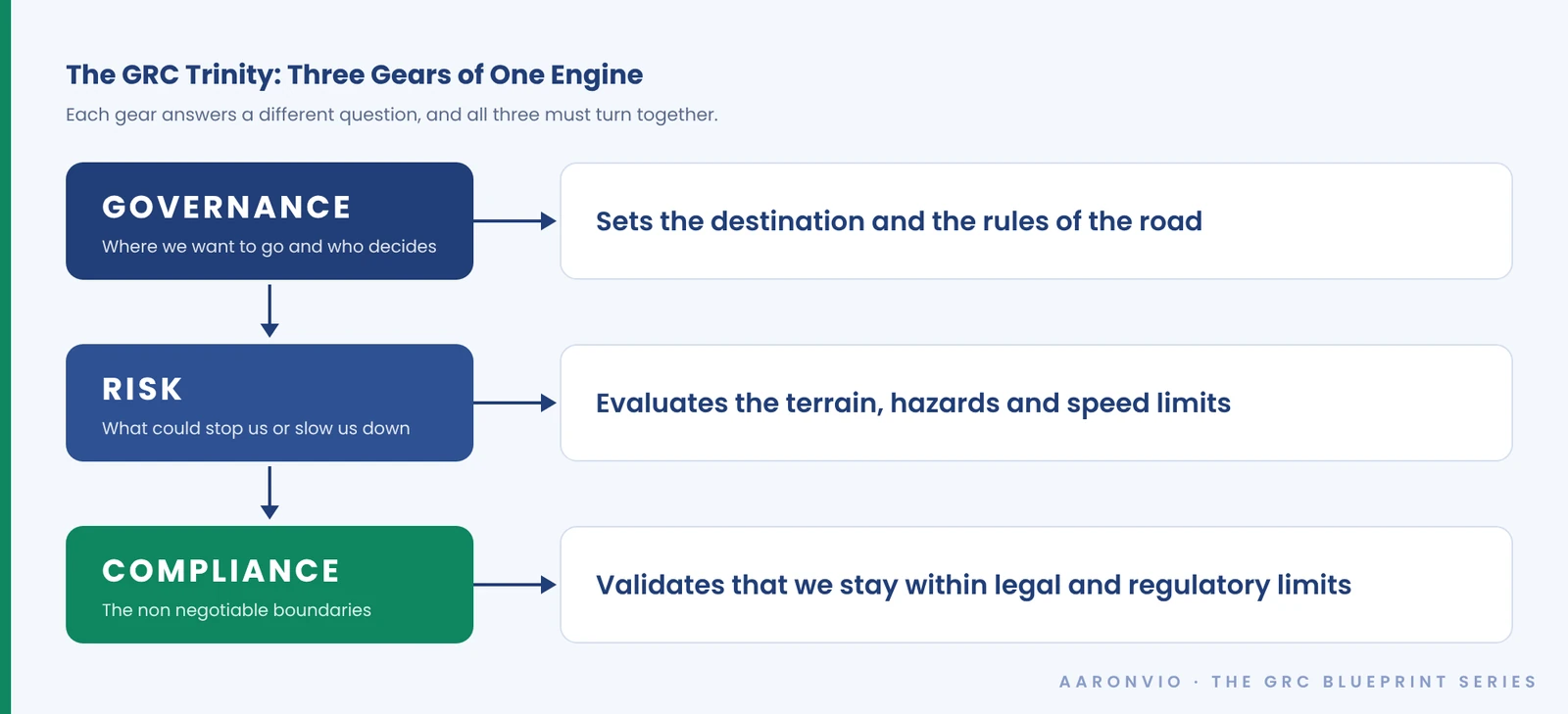
- Governance (Where we want to go and who decides): The structure through which business objectives are set, authorized, and monitored. It establishes corporate culture, Board oversight, and decision rights. It answers: “Are we doing the right things, in the right way, with proper authorization?”
- Risk Management (What could stop us or slow us down): The discipline of identifying, assessing, and treating uncertainty. Risk is not inherently bad; calculated risk-taking is how banks generate capital, issue credit, and scale. It answers: “What uncertainties exist, and are they within our approved risk appetite?”
- Compliance (The non-negotiable boundaries): The operational capability to consistently adhere to statutory laws, binding regulatory notices, supervisory rules (e.g., CBUAE, DFSA, FSRA), and contractual obligations. It answers: “Can we prove we operated within established legal and regulatory limits?
Why the Distinction Matters
When you confuse Risk with Compliance, you get critical blind spots. A bank can be 100% compliant on paper (every annual audit checklist ticked) and still harbor catastrophic residual risk (e.g., an unauthenticated API connected to an Open Finance partner). Conversely, treating Governance as pure policy writing disconnects executive leadership from operational engineering realities.
3. Regulatory Architecture: Regional & Global Framework Crosswalk
A mature GRC function never manages frameworks in silos. Running separate compliance programs for ISO 27001, PCI DSS, NIST, and regional supervisory mandates causes audit fatigue, redundant spending, and control bloat.
High-performing regional institutions deploy a Unified Control Framework (UCF) to harmonize international baselines with local regulatory standards:
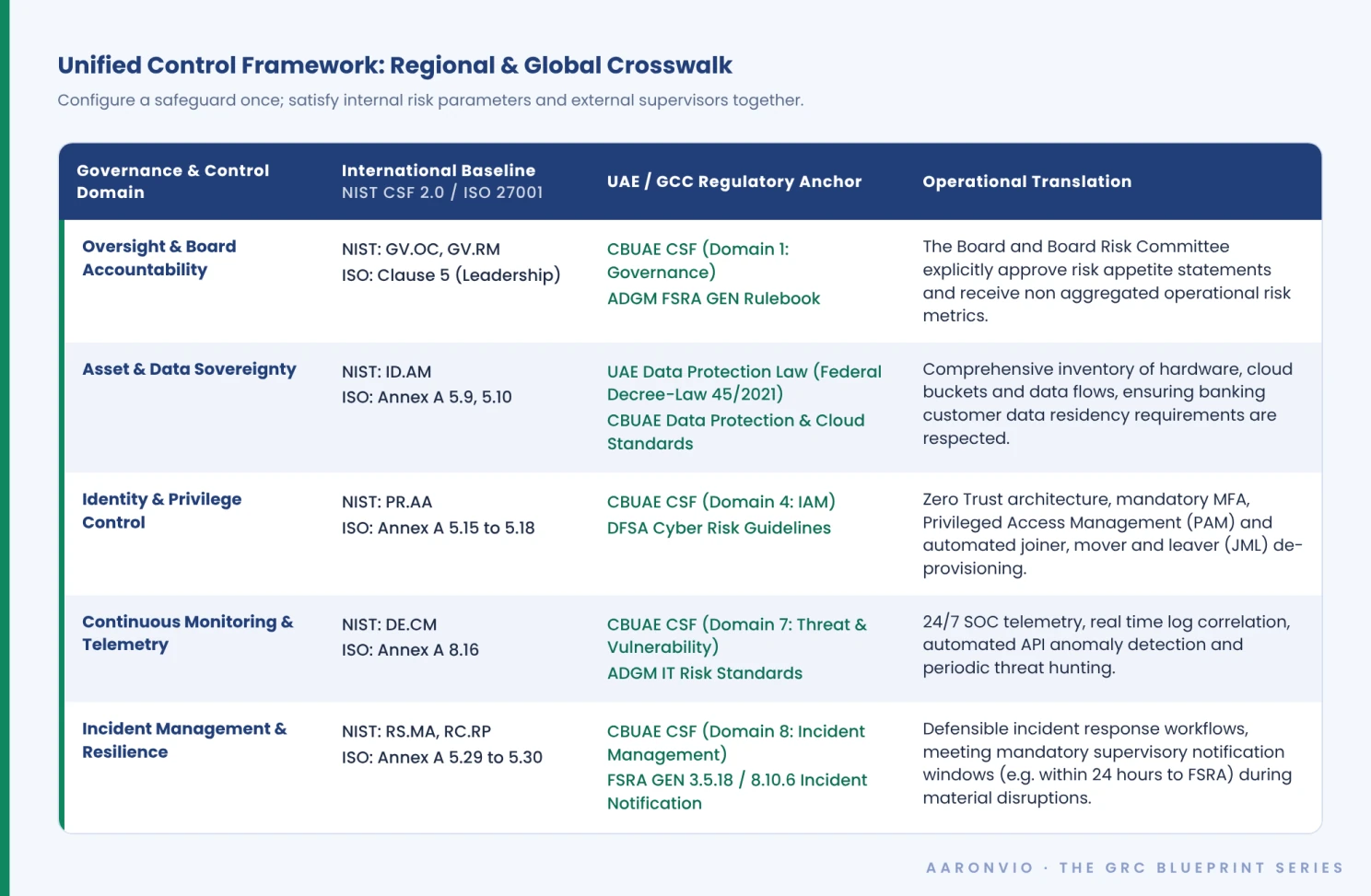
By harmonizing requirements into single, operationalized controls, engineers configure a safeguard once, while the GRC team satisfies both internal risk parameters and external supervisory examiners.
4. Accountability Structures: The Three Lines Model in Banking
Without clear ownership, risk management degenerates into finger pointing. Part 2 introduced the IIA Three Lines Model in principle; here is how it works in practice across every tier of a financial institution:
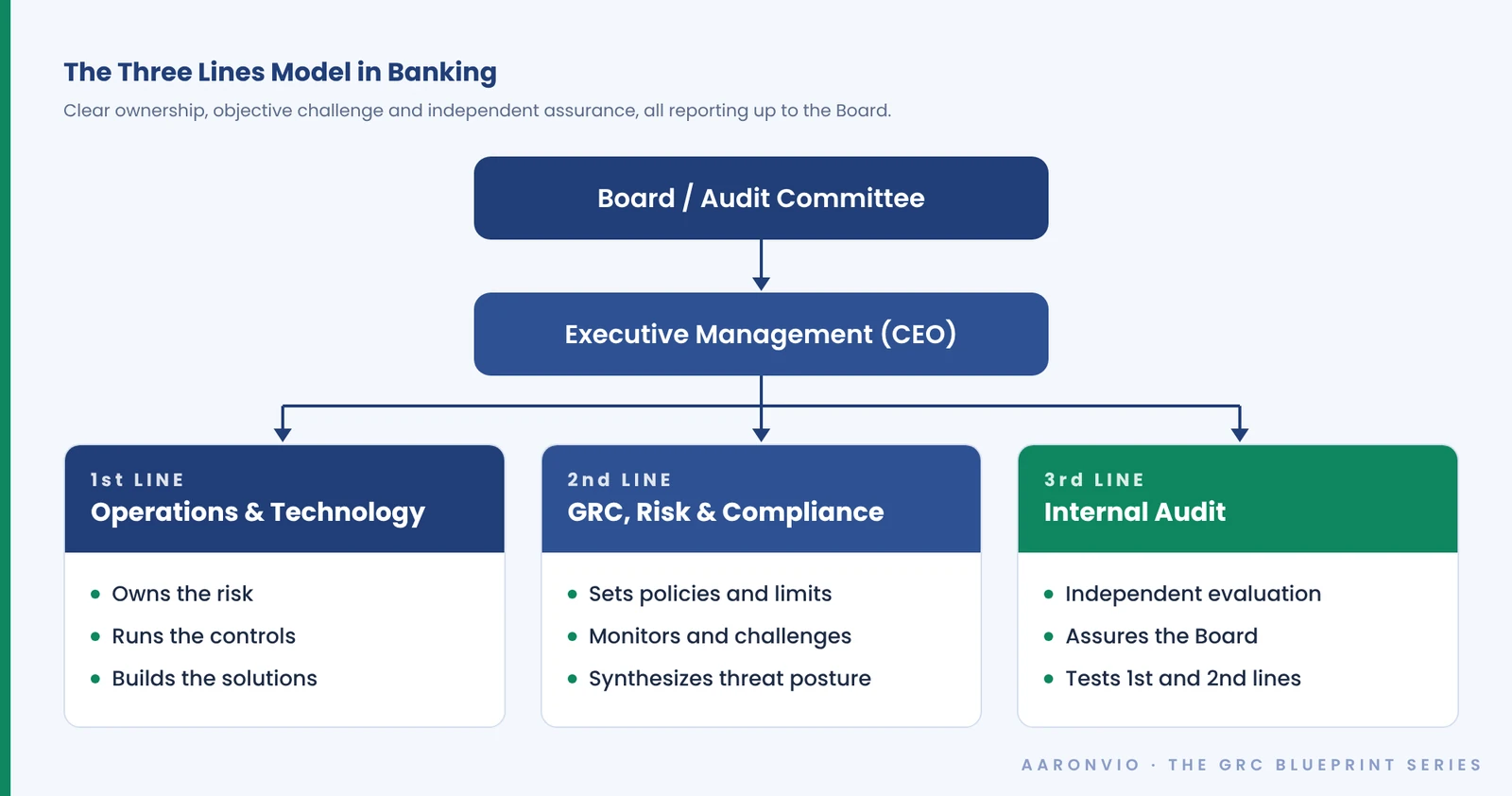
- The First Line (Business Units, Treasury, Digital Banking, DevSecOps): They own the risk. When a developer writes payment gateway microservices, an underwriting officer approves retail loans, or an operations clerk processes SWIFT transactions, they sit on the front lines. The First Line must design, embed, and run primary internal controls into everyday workflows.
- The Second Line (Chief Risk Officer, CISO, Head of Compliance): They provide policy, oversight, and objective challenge. The Second Line establishes risk measurement methodologies, manages regulatory relations (e.g., CBUAE/DFSA/FSRA interactions), and monitors whether First-Line operations remain within approved tolerances.
- The Third Line (Internal Audit): They provide independent, objective assurance directly to the Board’s Audit Committee. Free from day-to-day operational execution, Internal Audit validates whether the First- and Second-Line risk governance frameworks actually work in practice.
5. From Threat Modeling to RCSA: Making Risk Actionable
Enterprise risk is neither academic nor captured in a static spreadsheet. A functional risk management lifecycle flows dynamically from threat modeling to Board governance:
Step 1: Threat Modeling & Context Analysis
Threat modeling belongs in architecture and operational design, not just code reviews. Before writing controls, BFSI teams must evaluate:
- Adversaries: Advanced persistent threat (APT) groups targeting SWIFT corridors, ransomware syndicates, insider threats, and automated API-scraping networks.
- Attack Surfaces: Core banking APIs, corporate mobile applications, hybrid-cloud environments, and unmonitored third-party SaaS integrations.
- Business Impact: Clearing delays, liquidity pinches, data protection fines under UAE Federal Law 45/2021, and customer churn.
Step 2: Inherent vs. Residual Calculation
Building on the five step assessment formula from Part 2, risk must never be assessed in a vacuum. Evaluate the gap between unprotected exposure and mitigated posture:
- Inherent Risk: The raw exposure that exists before applying controls (e.g., exposing an Open Banking payment initiation API without mutual TLS or rate limits carries severe inherent risk).
- Control Effectiveness: How reliably technical, physical, and administrative safeguards reduce risk likelihood or business consequence.
- Residual Risk: The remaining exposure post-mitigation:
Residual Risk = Inherent Risk – Control Effectiveness
Step 3: Risk and Control Self-Assessment (RCSA)
The RCSA is the operational engine of banking risk management. Quarterly, First-Line process owners alongside Second-Line risk partners review their domains:
- What architecture or vendor modifications occurred this past quarter?
- Did controls experience drift, manual bypasses, or telemetry dropouts?
- Are Key Risk Indicators (KRIs), such as failed login spikes, patch lag, or API error rates, breaching early-warning thresholds?
Step 4: The Living Risk Register
A functional Risk Register is an active operational dashboard, not an administrative dumping ground. Every line item requires:
- Concrete Scenario: Replace vague labels like “Cloud Risk” with “Exfiltration of customer PII through unauthorized public read permissions on object storage.”
- Named Executive Owner: Assigned to an individual (e.g., Head of Digital Banking), never a generic team.
- Quantified Evaluation: Inherent and residual ratings tied to quantifiable operational impact limits.
- Defensible Treatment Strategy: Mitigate (implement controls), Transfer (insurance, indemnity terms), Avoid (cease activity), or Formally Accept (requiring Board-level sign-off above defined thresholds).
6. Real-World Case Studies: Lessons from Failure
A robust GRC culture is forged by understanding why real financial architectures break down:
Case 1: The Third-Party Cloud Misconfiguration
- The Incident: A major international consumer lender suffered an unauthorized intrusion exposing tens of millions of credit applications. The breach originated not from an exploit of the core ledger, but through a misconfigured Web Application Firewall (WAF) instance deployed on a public cloud provider.
- GRC Breakdown: While corporate policy mandated hardened cloud configurations, the bank lacked continuous, automated drift detection in production. First-line engineers deployed changes that bypassed baseline checks without triggering Second-Line alerts.
- Regional Regulatory Parallel: Under CBUAE’s CSF and Outsourcing Standards, licensed financial institutions bear ultimate accountability for controls hosted with third-party service providers. Cloud usage without continuous compliance telemetry results in direct supervisory intervention and directed remediation.
Case 2: Algorithmic Governance & Autonomous Failure
- The Incident: A high-frequency algorithmic market-making engine entered an unconstrained execution loop during volatile trading, executing hundreds of thousands of erroneous orders within minutes before engineers activated a manual kill switch.
- GRC Breakdown: Model governance was treated as an annual pre-deployment validation rather than a dynamic operational discipline. The institution failed to enforce runtime circuit-breakers, algorithmic velocity ceilings, and continuous anomaly alerting.
- Regulatory Expectation: Financial institutions deploying autonomous decision models or AI-driven customer onboarding must implement dynamic circuit breakers, continuous model-drift monitoring, and comprehensive model risk governance.
7. Operational Pitfalls and How to Overcome Them
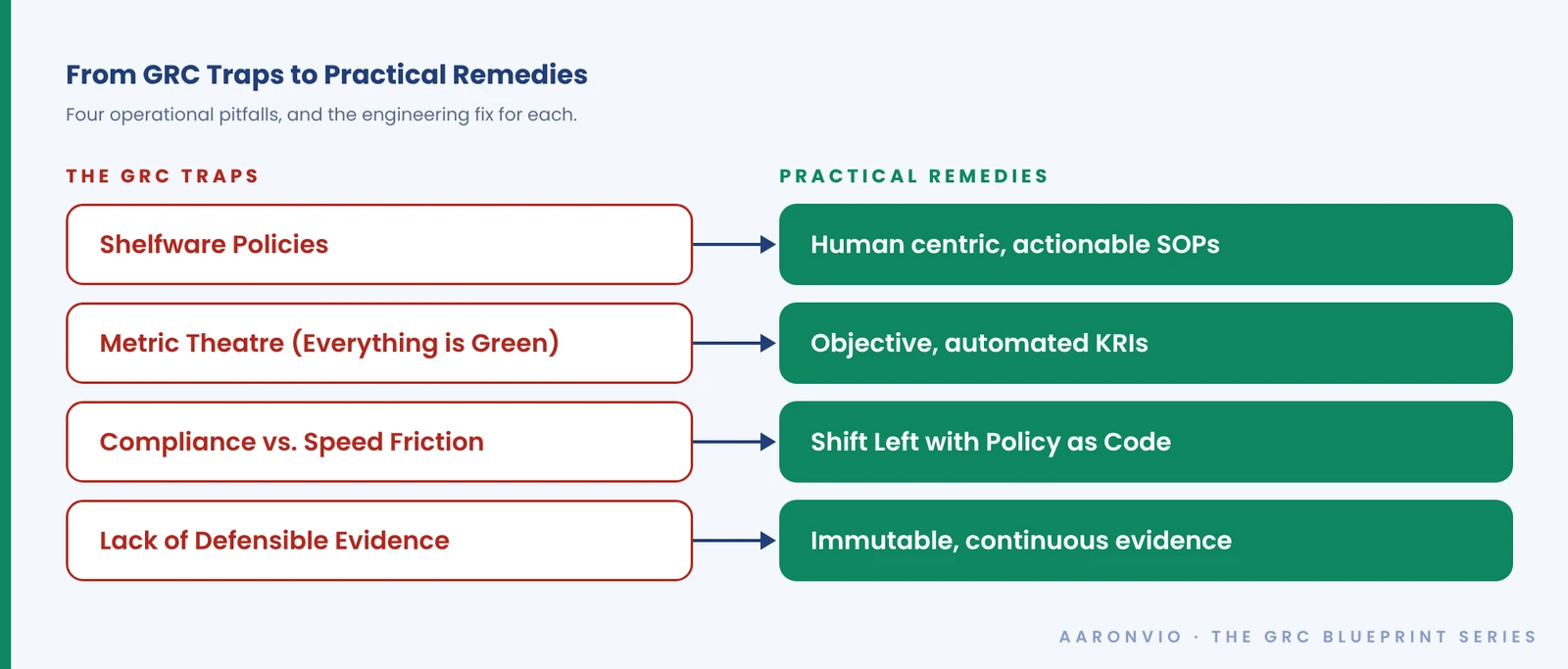
- Policy “Shelfware”: Dense, 100-page manuals written in legalistic jargon that sit unread on internal portals while engineers ship unmonitored code. Remedy: Keep core policies concise, approved at Board level, and translate them into modular Standard Operating Procedures (SOPs) and technical standards embedded directly into developer pipelines.
- The “Everything-is-Green” Illusion: Executive dashboards that show green across all indicators quarter after quarter. If an operational risk dashboard shows no amber or red indicators, leadership is flying blind. Remedy: Reward transparency. Early detection of control failures, near-miss events, and architectural drift should be treated as evidence of a healthy, functioning defense system.
- The “Department of No”: Compliance teams acting as friction points, halting digital banking deployments days before scheduled go-live. Remedy: Shift compliance left. Codify guardrails as Policy-as-Code (e.g., automated checks within CI/CD pipelines). If an Infrastructure-as-Code template fails to encrypt an account database or exposes open ports, the build fails automatically with clear remediation instructions.
- Lack of Defensible Evidence: An external examiner, state regulator, or internal audit team has a straightforward retort: “Prove it.” Remedy 01: Keep Evidence Continuous. Do not spend four weeks manually assembling screenshots before an audit. Script evidence collection so that configurations, access lists, and logs export continuously into a tamper-evident data store. Remedy 02: Control the Narrative. Provide auditors with clear documentation up front. Define the control, show its owner, display the operational procedure, and present the corresponding log sample directly. Never let an auditor guess how your control works.
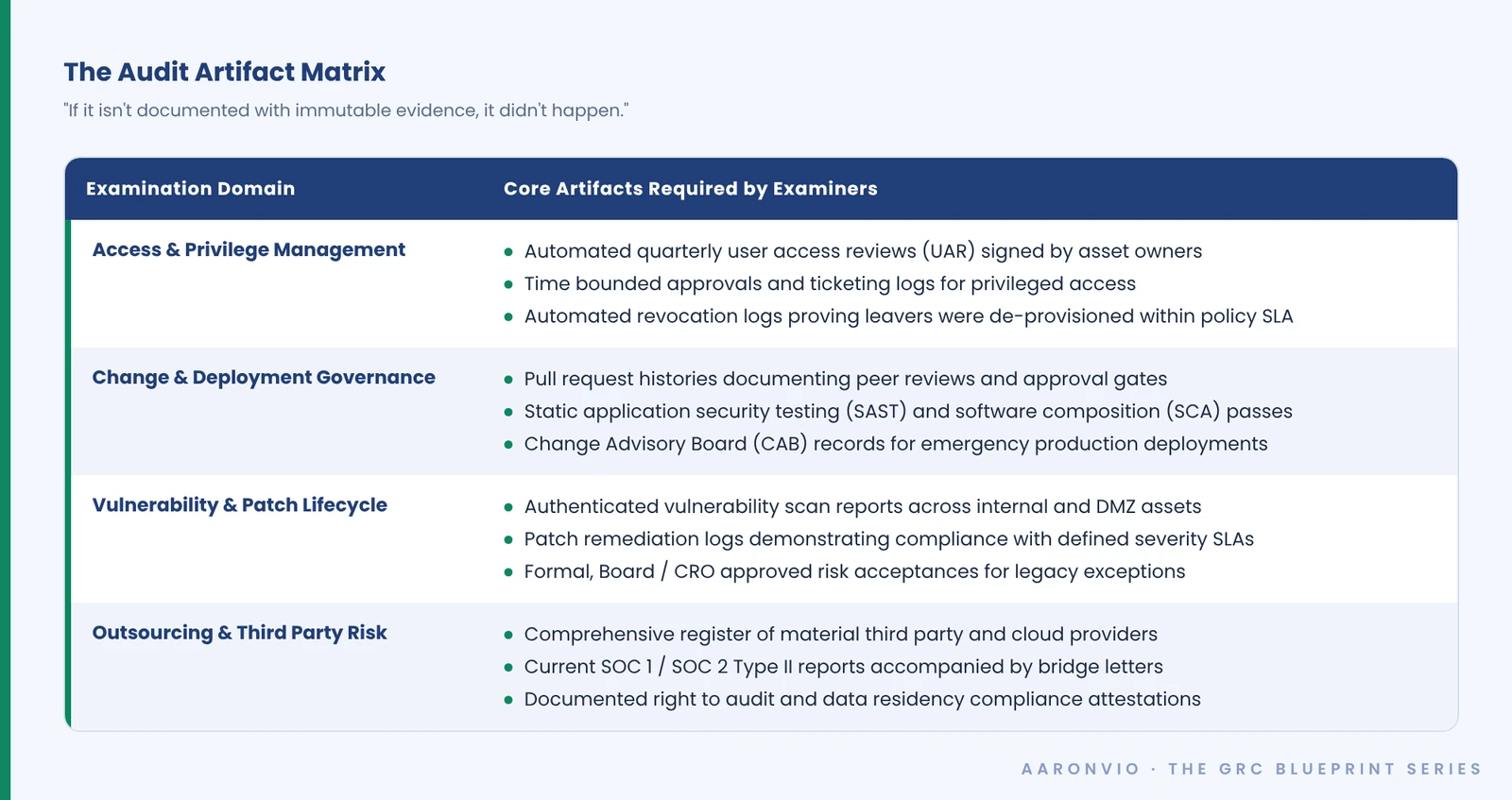
8. Defensibility & The Audit Artifact Matrix
When a supervisory examiner from the Central Bank or an external auditor walks into the room, their operating posture is simple: “If it isn’t documented with immutable evidence, it didn’t happen.“
Defensibility requires the capability to reconstruct historical security, risk, and authorization postures on demand:
9. Action Required: Sft from Regulatory Obligation to Enterprise Value
When GRC is operated merely as a defensive shield, it remains an expensive cost center. But when engineered with precision and anchored to regional supervisory standards, GRC drives measurable business value:
- Expands Market Trust: In regional and global banking, a proven governance posture accelerates institutional partnerships, unlocks correspondent banking relationships, and attracts institutional deposits.
- Enables Rapid, Safe Innovation: Engineering teams operating with clear, automated compliance boundaries can deploy digital products, integrate Open Banking APIs, and adopt modern infrastructure without fear of regulatory shutdown.
- Safeguards Operational Continuity: Rigorous, continuous GRC ensures that technical faults, vendor failures, and market turbulence remain manageable incidents rather than systemic existential events.
GRC is not a bureaucratic tax.
Engineered correctly, GRC is the high-performance operating system of a resilient financial institution.
Veteran’s Parting Advice: Three Foundations to Remember
If you take only three lessons from Part 3, take these:
- Governance decides, Risk measures, Compliance proves. Confusing the three creates blind spots that no audit checklist will ever catch.
- Build each control once, then map it many times. A unified control framework turns CBUAE, DFSA, FSRA, ISO and NIST obligations into one operating rhythm instead of five competing programs.
- Evidence is a byproduct of good operations, not a project. If proving a control takes four weeks of screenshots, that control is not yet operational.
Coming Next in Part 4
Institutional Red Flags & Operational Pathology: Root Cause Remediation
Foundations explain how GRC should work. In Part 4, we examine how it actually fails: the institutional red flags that signal a GRC program is decaying, the operational pathologies behind repeat audit findings, and how to remediate at the root cause rather than treating symptoms.
Catch Up on the Series
Part 1: Navigating Cyber, Cloud, and the AI Frontier
Part 2: A Veteran’s Blueprint for Modern GRC in BFSI & Beyond
Readers are invited to share their questions and experiences in the comments. Your feedback shapes the parts that follow.