Introduction
When a major breach, an algorithmic glitch, or an embarrassing audit failure shakes a financial institution, leadership almost always expresses shock. The dashboard was green last week. The policy manual had fresh digital signatures. The controls were signed off.
Over forty years in information security and Governance, Risk, and Compliance (GRC), including two decades navigating the banking corridors of the UAE, I have watched this tragedy unfold repeatedly. Systems rarely fail because people do not understand the math of cryptography or the syntax of an AI prompt. They fail because the institution suffered from an unaddressed operational pathology: treating governance as a theatrical performance rather than the central operating nervous system of the enterprise.
To build an organization capable of scaling safely into the era of autonomous AI and hybrid cloud, we must move beyond defensive paper-pushing and confront institutional red flags at their root.
1. Executive Summary and Regulatory Trigger:
The modern financial institution operates under intense scrutiny. Regulators across the globe, notably the Central Bank of the UAE (CBUAE) with its stringent Consumer Protection Standards and Cybersecurity Framework, the Dubai Financial Services Authority (DFSA), and the Financial Services Regulatory Authority (FSRA), have decisively moved away from “box-checking” examinations.
Regulators no longer accept a binder on a shelf as proof of resilience. The modern trigger for regulatory intervention is rarely the sheer absence of an IT policy; it is the divergence between written intent and operational reality.
When a critical system goes down, customer data leaks via an unvetted large language model (LLM) agent, or a rogue access path persists for months, enforcement teams ask three questions:
- Did the Board know this risk existed?
- Did internal mechanisms actively surface or actively suppress the problem?
- Was capital prioritized for growth while risk remediation starved?
Governance that fails to protect core business objectives (profitability, capital adequacy, operational uptime, and brand equity) is not governance. It is institutional overhead.
2. Regulatory Architecture: The Dual-Track Reality
Modern GRC operates across two interconnected layers: the Statutory Mandate and the Internal Operating Blueprint.
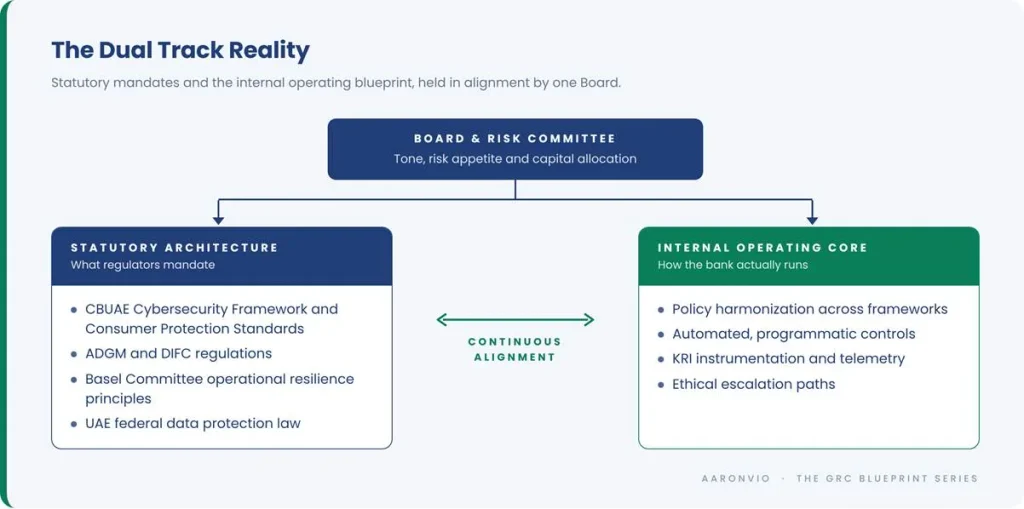
Dual Track Governance: the Board sets the tone, regulators set the floor, and the internal operating core keeps both in continuous alignment.
The Statutory Layer: In the UAE and broader global BFSI ecosystems, frameworks are designed to protect systemic liquidity and customer trust:
- Prudential Oversight: Focuses on operational resilience, systemic interdependencies, business continuity planning (BCP), and disaster recovery (DR).
- Conduct and Data Sovereignty: Driven by UAE Federal Decree-Law on Personal Data Protection, CBUAE data localization mandates, and ethical guidelines for financial algorithms.
The Operational Architecture: Within the enterprise, regulatory mandates must translate into concrete, measurable artifacts:
- Control Registries: Living, automated verifications of configuration and behavior rather than annual manual attestations.
- Telemetry Lines: Pipelines linking operational logs directly into Key Risk Indicators (KRIs).
- Feedback Loops: Clear escalation paths where operational friction immediately triggers policy review rather than covert workarounds.
3. Governance Terminology and Practical Interpretations
Jargon often conceals operational weakness. Translating theoretical compliance language into operational reality clarifies accountability:
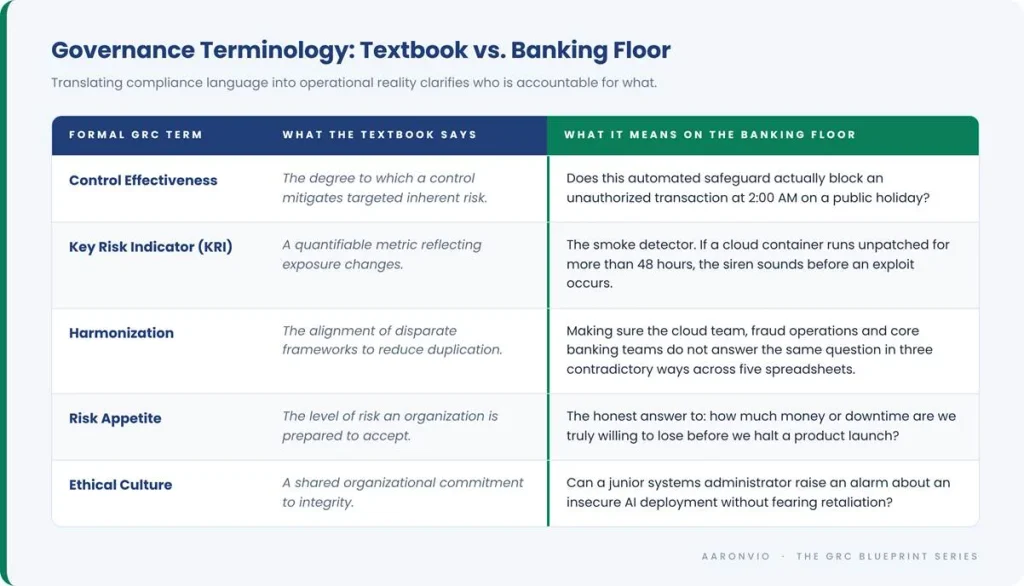
Governance Terminology: what the textbook says versus what it really means on the banking floor.
4. Case Studies, Institutional Red Flags, and Root Cause Remediation
Here is how operational pathologies manifest in practice across the eleven critical GRC vectors, drawn from patterns observed across BFSI institutions.
Case 1: The “Paper Tiger” Controls and Policy Drift
- Vectors Covered: Lack of Controls, Policies & Procedures, Documentation, Harmonization.
- The Scenario: A prominent regional retail bank experienced an internal data leak. Customer financial profiles were siphoned via an orphaned reporting server running in an unmonitored sub-network. During the review, the compliance department produced a comprehensive, approved “Information Classification and Access Policy.” However, the system administrator had bypassed multi-factor authentication (MFA) because the legacy application kept crashing when modern authentication was enforced.
- The Institutional Red Flag: Documentation without verification. The policy was signed; the control did not exist programmatically. Furthermore, the cloud transition team and the on-premise infrastructure team used separate, unharmonized configuration guides.
- The Regulatory Fallout: Significant administrative fines under CBUAE consumer data directives, accompanied by a mandatory external audit mandate costing three times the original control’s budget.
- Remediation Blueprint: 1. Kill the shelfware: Convert qualitative policy statements into “Policy-as-Code” (e.g., using Open Policy Agent or automated cloud guardrails) that systematically prevent non-compliant deployments. 2. Harmonize frameworks: Consolidate NIST CSF, ISO 27001, and CBUAE controls into a single internal matrix. If an application cannot enforce the unified baseline, it cannot be hosted on the corporate network.
Case 2: The Muted KRI and Incident Siloing
- Vectors Covered: Incident Management, Monitoring/KRI, Audit Review, Reporting.
- The Scenario: An investment bank faced intermittent algorithmic trading anomalies. The IT operations desk treated the alerts as routine “software timeouts,” restarting the service without deeper triage. Because IT, Cybersecurity, and Fraud operated in isolated operational silos, the fraud team missed the fact that those brief outages were being weaponized by an external actor conducting slow-and-low balance manipulations. Internal Audit had checked the “Incident Log” six months prior and closed the ticket because the mean-time-to-resolution (MTTR) looked artificially low.
- The Institutional Red Flag: Vanity reporting and disconnected monitoring. The metric monitored was “ticket closure speed” rather than “unresolved pattern recurrence.” Audit reviewed log existence, not log intelligence.
- Remediation Blueprint: 1. Integrated Command Center: Merge operational telemetry from Security Operations (SOC), Network Operations (NOC), and Fraud Analysis into a shared data lake. 2. True KRIs over KPIs: Shift metrics from number of alerts closed to mean time to detect (MTTD) anomalies across business logic. 3. Adversarial Auditing: Internal audit must shift from reading past ticket notes to executing live, unannounced scenario testing (“purple teaming”).
Case 3: Starvation, Blame Culture, and the AI Blindspot
- Vectors Covered: Ethics & Culture, Training & Awareness, Resource Allocation.
- The Scenario: To accelerate digital loan approvals, a business unit deployed a third-party generative AI scoring copilot. The compliance and security team raised concerns, but their budget for specialized AI auditing tools had been reallocated to marketing initiatives. Employees were given a generic 20-minute annual video for compliance training that did not mention generative models. Consequently, loan officers entered raw, unmasked customer credit histories into public AI interfaces to speed up summary generation.
- The Institutional Red Flag: Culture of circumvention driven by resource imbalance. When compliance is viewed strictly as a cost center, teams starve it of the tooling required to safely enable innovation.
- Remediation Blueprint: 1. Tied Resource Allocation: Mandate that a fixed percentage (typically 12 to 15%) of any new digital transformation or AI business budget is ring-fenced specifically for continuous assurance, threat modeling, and GRC automation. 2. Contextual, Role-Based Enablement: Replace rote, check-the-box annual training with monthly, workflow-specific micro-simulations. Show a developer or a credit officer exactly how data leaks occur in their specific applications. 3. Psychological Safety for Whistleblowing: Establish clear, transparent mechanisms where flagging a high-risk operational shortcut is rewarded rather than penalized as a business delay.
Case 4: The C-Suite Turf War: Who Actually Owns Data Privacy and Protection?
- Vectors Covered: Lack of Controls, Policies & Procedures, Ethics & Culture, Resource Allocation, Harmonization.
- The Scenario: Following the enforcement of the UAE Federal Decree-Law on Personal Data Protection alongside CBUAE Consumer Protection directives, the Group CEO of a major regional bank convened an executive session to assign institutional accountability for Data Privacy and Protection. What should have been an operational alignment meeting quickly unraveled into an executive stalemate: o The Head of Legal asserted ownership, arguing privacy is fundamentally statutory, contractual, and regulatory compliance. o The Chief Risk Officer (CRO) claimed it belonged under Non-Financial / Operational Risk, arguing that data exposure is an enterprise risk posture issue. o The CISO and the Security Head insisted privacy without technical data security is an illusion, pointing to encryption key management, Data Loss Prevention (DLP), and identity boundaries. o The Head of IT wanted oversight because data physically resides within their infrastructure, pipelines, and hybrid cloud repositories.
Paralyzed by competing egos and overlapping mandates, the CEO hesitated. In the ensuing six-month jurisdictional vacuum, neither a formal Data Protection Officer (DPO) nor a unified data classification program was operationalized. When a third-party wealth management analytics vendor suffered an API credential leakage, each executive pointed fingers: Legal blamed IT for vendor onboarding checks; IT blamed the CISO for lack of tokenization; the CISO noted Risk never classified the dataset as high-impact.
- The Institutional Red Flag: Confusing custodianship with stewardship and governance: When everyone claims a piece of a critical discipline without a structural RACI (Responsible, Accountable, Consulted, Informed) framework, collective ownership becomes zero ownership. Turf wars in the executive suite create operational paralysis down the ranks, leaving engineers and frontline relationship managers with no clear guidance on who authorizes data flows.
- The Regulatory Fallout: Under CBUAE and data protection supervisory scrutiny, the bank was penalized for failing to establish clear governance and lacking an independent, designated data protection reporting line. Regulators noted that internal friction directly prolonged the breach detection window.
- Remediation Blueprint: The CEO must cut through the political noise by separating Statutory Oversight, Risk Governance, Technical Enforcement, and Operational Custodianship.
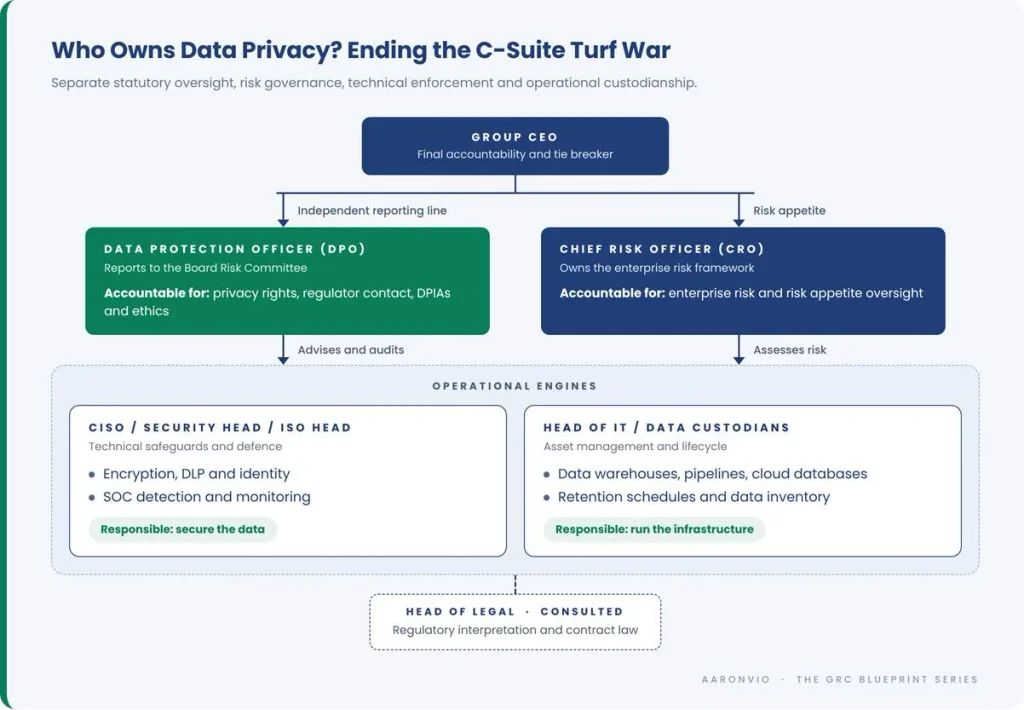
Ending the Turf War: one clear structure separates statutory oversight, risk governance, technical enforcement and operational custodianship.
1. Establish an Independent Data Protection Officer (DPO): Data Privacy cannot report directly into IT or Cybersecurity without an inherent conflict of interest. The CISO focuses on confidentiality, integrity, and availability (defending the perimeter and access); IT focuses on uptime, performance, and storage. The DPO focuses on the rights of the data subject, lawful basis of processing, data minimization, and regulatory transparency.
- Structure: Appoint a dedicated DPO who reports to the Board Risk Committee or administratively to the CRO/General Counsel, with an unhindered direct-escalation line to the CEO.
2. Deploy a Clear RACI Matrix across the Executive Table:
- Chief Risk Officer (CRO), Accountable for Risk Appetite: Embeds data privacy into the enterprise risk management (ERM) framework and capital risk calculations.
- Data Protection Officer (DPO), Accountable for Regulatory Privacy & Compliance: Serves as the single contact point for regulators (CBUAE, Data Office), signs off on Data Protection Impact Assessments (DPIAs), and manages data subject access requests (DSARs).
- Head of Legal, Consulted on Legal Interpretation: Advises on statutory interpretations, regulatory enforcement defense, and cross-border commercial data contracts.
- CISO / Head of Security, Responsible for Technical Protection Controls: Implements zero-trust architectures, access control models, encryption at rest/in transit, and incident triage.
- Head of Information Security Operations (ISO), Responsible for Detection & Monitoring: Manages the telemetry, audits access anomalies via SIEM/SOAR, and runs continuous control testing.
- Head of IT, Responsible as Data Custodian: Implements data retention schedules, maintains accurate inventory of data stores, and ensures patch and pipeline integrity.
3. Enforce Business Objectives over Territorial Silos: The CEO must tie performance incentives (KPIs/remuneration) to cross-functional delivery. For instance, launching an AI credit-scoring tool requires joint sign-off: IT verifies compute architecture, CISO verifies tokenization, DPO confirms lawful processing consent, and Risk assesses inherent bias. If one fails, the product halts.
5. Operational Pitfalls, Friction, and Practical Precautions
Remediating these systemic failures introduces immediate operational friction. Recognizing and managing these friction points determines whether reforms succeed or stall:
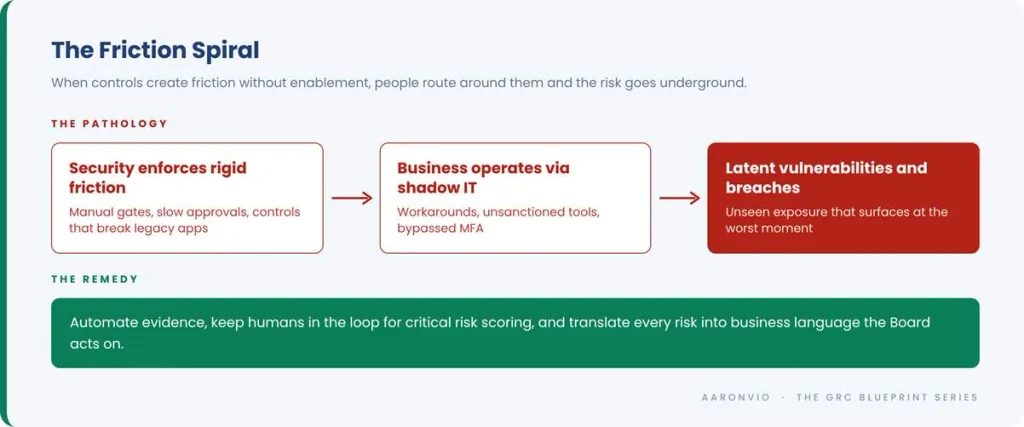
The Friction Spiral: when controls create friction without enablement, the business routes around them and the risk goes underground.
- The “Audit Fatigue” Pitfall: Flooding operational teams with endless spreadsheets creates a culture of defensive compliance, where engineers spend more time filling out forms than patching production clusters. Precaution: Automate evidence collection. Connect GRC platforms directly to source control repositories, cloud providers, and ticketing systems via APIs to collect evidence without manual human intervention.
- The “False Sense of AI Security”: Relying on off-the-shelf AI models to monitor compliance without human oversight introduces hallucinated risk assessments. Precaution: Implement human-in-the-loop validation for all critical risk scoring. Subject internal AI risk engines to independent model validation, just as you would an interest rate risk model.
- The Executive Communication Gap: Presenting technical security metrics (e.g., “port scans detected” or “vulnerabilities triaged”) to the Board breeds apathy. Precaution: Translate every risk into financial and operational language: capital at risk, estimated downtime in trading hours, potential regulatory capital surcharge, or customer churn exposure.
6. Practical Recommendations for the Board and the Trenches
After decades in the field, I distill real institutional transformation down to four core disciplines:
- Build Single Sources of Truth (Harmonize Now): Eliminate disparate spreadsheets across departments. Maintain one unified enterprise risk register, linked directly to operational controls and statutory requirements. When a regulation changes, the corresponding technical controls, monitoring hooks, and operational procedures must update across the enterprise systematically.
- Make Controls Programmatic, Not Manual: If a human has to remember to lock a digital door every Friday afternoon, that door will eventually remain open. Enforce security configurations through immutable infrastructure, automated identity lifecycle management, and strict zero-trust network architectures. Manual checks should validate the automated system, not perform the baseline work.
- Tie Capital directly to Risk Posture: If a business line generates high revenue while repeatedly blowing past its assigned operational risk tolerance, that risk must reflect directly on its profitability metrics. Incorporate risk-adjusted returns on capital (RAROC) into business line evaluations to immediately align commercial incentives with regulatory discipline.
- Foster a Culture of Ruthless Operational Candor: The ultimate institutional safeguard is not an algorithm, a firewall, or a policy document. It is an organization where bad news travels faster than good news. When an engineer or risk analyst discovers a flaw in a critical system, executive leadership must welcome that disclosure as an opportunity to reinforce the enterprise before the market or the regulator finds it for them.
Compliance is not the ceiling of what is required; it is the absolute floor. Treat governance as the high-performance braking system on a racing vehicle: it does not exist to slow you down, but to give you the confidence to run faster and innovate safely without flying off the track.
Catch Up on the Series
- Part 1: GRC Blueprint, Navigating Cyber, Cloud and the AI Frontier
- Part 2: A Veteran’s Blueprint for Modern GRC in BFSI and Beyond
- Part 3: Deconstructing Foundations, Governance, Risk and Compliance in Action
Which of these red flags have you seen in your own institution? Share your experience in the comments.